
Disclaimers
The written record on historic lesbians is sparse. Given the time period, minimal surviving records, and the lack of overarching cultural terms, the people and relationships I write about may or may not have considered themselves ‘lesbians’ within our current cultural definitions.
I am making no specific claims about Sappho’s overall identity, only that she explicitly wrote about desire in the context of female same-sex attraction.

Ah, Sappho.
The term ‘sapphic’ comes from her name, lesbians are named after the isle she is from — Lesbos — and for thousands of years, men have twisted her words in translations and interpretations, stripping them of all desire, masking her intentions, and equating her desires for women to simple friendship, or even an overt love of men.
Let’s take a look at how the male historians and orators have referred to her over the years, shall we?
“Lusty, vulgar whore woman who sang about her own sexual depravity” — Tatian 1st century. CE
“Accused by some of being irregular in her ways and a woman-lover” — Oxyrhynchus papyrus 2nd-3rd century CE
“Slanderously accused of shameful intimacy with her female pupils”1 — the Suda 10th century / Byzantine encyclopedia
Her desire for women “was entirely idealistic and non-sensual” — Friedrich Welcker 19th century
“Nothing but a friendly affection” — Karl Müller 19th century
Who was Sappho?
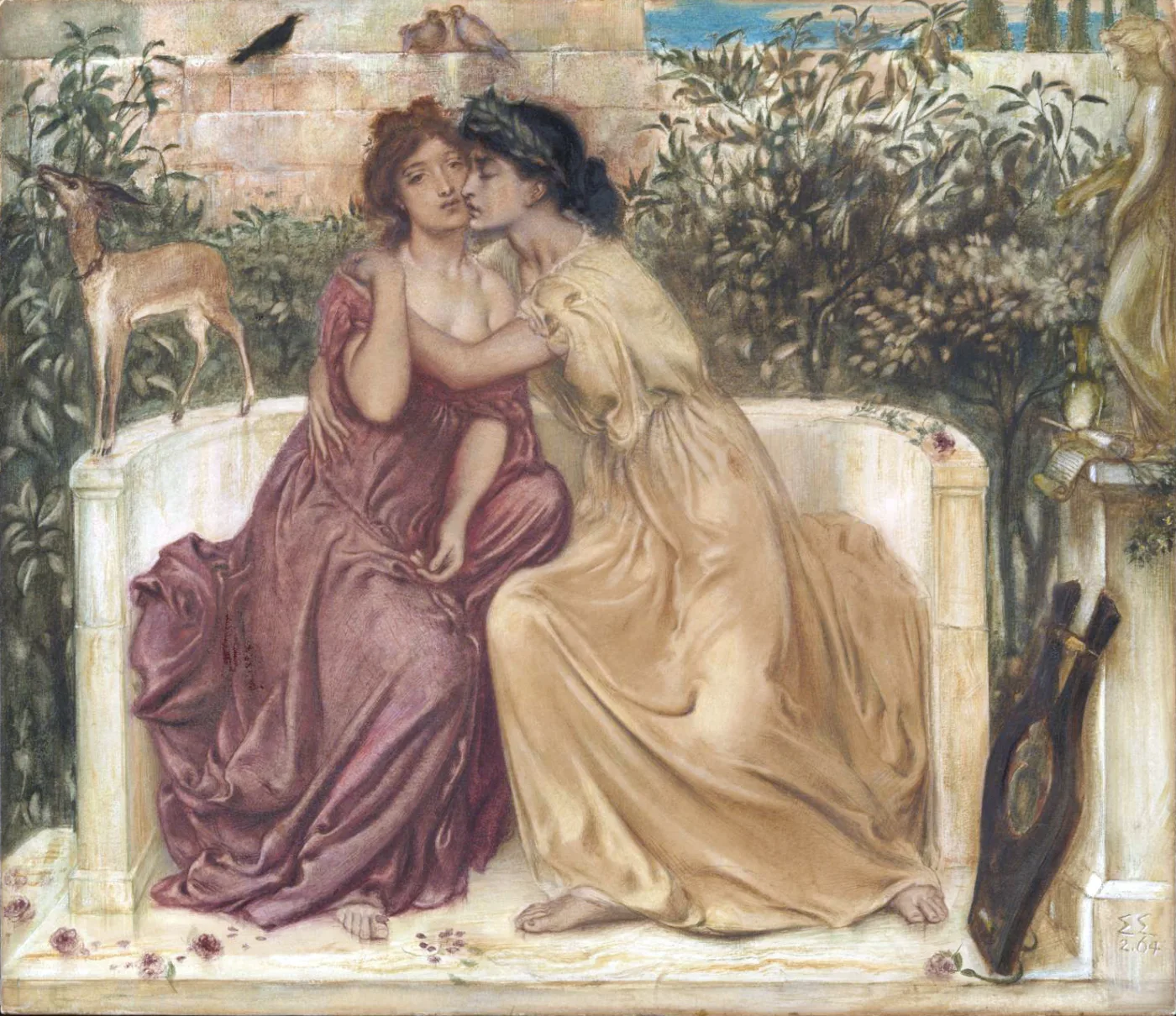
Sappho is widely considered to be one of the most famous and prolific poets of all time, likened to a female Homer. She lived about 2,500 years ago on the Isle of Lesbos (6th-5th century BCE). Her poetry was unique to her island and it was meant to be sung accompanied by an instrument- often a lyre.
She was also one of the first Greek poets to use first-person language in her poetry, which has further solidified the understanding that her writings were autobiographical in nature. She wrote lines that explored her own personal feelings and desires.

But Sappho isn’t just revered in retrospect, she was highly respected within her contemporary society as well. She was referred to as “The Poetess” and later dubbed as the 10th muse by Plato. Her legacy was solidified through her portrayal on vases, paintings, sculptures, and coins in antiquity, and her poems were copied and distributed widely through antiquity.
Sappho’s poems often focused on love; more specifically, romantic and sexual desire between two women. While much of her writing has been lost to time, her talent was deeply appreciated by her contemporaries and beyond, that writings also exist abouther to give us more information on her life, impressions, poetry, and intentions.
One deep dive a month, straight to your inbox.
Inventing a husband for her

In at least one later Greek comedy that was recorded in the Suda (10th c.), Sappho was portrayed as heterosexual woman and was married to a man who’s name and place of origin genuinely translates to “Dick All-Cock from the Isle of MAN” in English.
That name is so clearly a pun from a satirical ancient Greek play.
However, it was utilized by translators in the 1800s as proof that she was definitely a heterosexual woman.
During the Roman period another lyric poet, Horace, called her “masculine Sappho”, which the later Porphyrio commented was “either because Sappho had engaged in the masculine pursuit of writing or because she was a tribade.”2
Later, more mythos around our beloved Sappho were born. The one most tightly clung to being that she flung herself from a cliff, due to her desperate longing and heartbrokenness over the ferryman Phaon. This aspect of her lore was pushed deep into the zeitgeist surrounding Sappho and her works during the 19th century, as this story was evidence that she was heterosexual, and therefore fit neatly into the societal morality clauses of art and what a woman should be.
Translations that rewrote history
In 1711, Ambrose Phillips’ translated Sappho’s famous “Ode to Aphrodite” and changed the gender of subject of the work to be male, and substituted male pronouns for the object of desire. This translation was widely used until the 20th century:
“Tho now he shuns thy longing arms, He soon shall court thy slighted charms; ”3
…. You get the point.
The ‘virgin schoolmistress’ theory
Scholars have long debated the context in which her poetry was performed and her role in society. The same argument shows up around gender in the temples of Inanna-Ishtar. In 1913 a popular theory by Fredrick Welcker arose, positing that she was a virgin schoolmistress, as a way to explain and justify the references of love for her ‘girls’ within the writings.
As one critic of this theory put it, he was “concerned with defending Sappho from charges of homosexuality.”4
This particular theory stripped away any desire, sexuality, physical attraction of her poems about other women and chalked it up to platonic love and simple care for her students.
Translations that put it right

And then finally, in 2014 a woman published her updated translations.
Sappho Fragment 102, translated by Diane Rayor (2014):
Sweet mother, I cannot weave — slender Aphrodite has overcome me with longing for a girl.”
Sappho’s writing “clearly celebrate eros between women” — Sandra Boehringer 2014
While modern scholars are still pushing up against this centuries-long queer erasure in the translations and interpretations of Sappho, her poetry is slowly being appreciated within its complexities and their true entirety once more. This did not stop with Sappho. Two thousand years later an English newspaper explained away a marriage between two women in Poplar the same way.
Her poems were meant to be sung aloud, accompanied by a lyre. The stage where Athens staged its own drama is still standing, and it is the stop most people walk straight past.
References
1. The Suda – https://www.cs.uky.edu/~raphael/sol/sol-entries/sigma/107
2. Schachter, Marc. “On Lesbian Acts and Female Pleasures in Juvenal Commentaries from Antiquity to 1500” Durham University https://jps.library.utoronto.ca/index.php/renref/article/download/26372/19559/59278
3. Phillips, Ambrose “Pastoral, epistles, odes, and other original poems with translations from Pindar, Anacreon, and Sappho”J & R Tonson and S Draper – London (1748)
4. Parker, Holt N. “Sappho Schoolmistress.” Transactions of the American Philological Association (1974-) 123 (1993): 309–51. https://doi.org/10.2307/284334.
